Removing Bioceramic Sealer Remnants using Er,Cr:YSGG laser Irradiation with PIPS Process: In Vitro Study
Article Sidebar
Main Article Content
Abstract
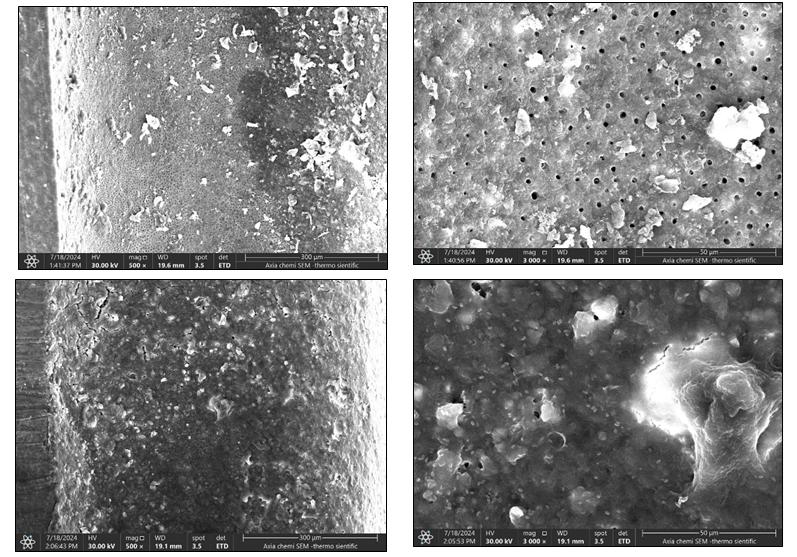
Background: This vitro study investigated the effectiveness of Er,Cr:YSGG laser-activated irrigation in removing root canal filling remnants during endodontic retreatment. The technique used photon-induced photoacoustic streaming (PIPS) at 700 μs pulse duration to activate 2.5% sodium hypochlorite (NaOCl) and 17% EDTA. Materials and methods: Twenty-one extracted human maxillary and mandibular premolars with single roots were instrumented and obturated using gutta-percha and a bioceramic root canal sealer. After retreatment using nickel-titanium rotary files (XP-endo Retreatment), the specimens were randomly assigned into three groups (n=7 per group) according to the irrigation technique: Group 1: conventional syringe irrigation (control), Group 2: passive ultrasonic irrigation, Group 3: laser-activated irrigation using Er, Cr:YSGG laser (2780 nm, 700 μs pulse duration, 5 Hz, 1 W, RFT2 tip, with no air or water spray). All samples were sectioned longitudinally and examined under a scanning electron microscope (SEM) to assess the presence of residual filling materials in the coronal, middle, and apical thirds. Cleanliness scores were assigned by two calibrated endodontists based on a 4-grade scoring system and were statistically analyzed using one-way ANOVA followed by Tukey’s post hoc test. The significance level was set at α = 0.05. Statistical analysis revealed a significant difference among the groups (P < 0.05). Group 3 showed significantly lower residual debris compared to Groups 1 and 2 across all root thirds, while the difference between Groups 1 and 2 was not statistically significant (P > 0.05).
Results: Group 3 (n = 7) exhibited significantly lower residual debris compared to Groups 1 and 2 across all canal thirds (P < 0.05). The mean cleanliness scores were highest in the coronal third, followed by the middle and apical thirds. No statistically significant differences were observed between Group 1 and Group 2 (P > 0.05), suggesting limited effectiveness of ultrasonic irrigation compared to laser activation.
Conclusion: The use of Er,Cr:YSGG laser-activated irrigation with PIPS at a 700 μs pulse duration, combined with 2.5% NaOCl and 17% EDTA, significantly improved the removal of root canal filling remnants during retreatment. These findings suggest that laser-activated irrigation may serve as an effective adjunct to conventional retreatment protocols, offering enhanced cleaning efficacy across all canal levels.
Received 8 Apr.2025, Revised 15 Jul. 2025, Accepted 8 Aug. 2025, Published 15 Dec. 2025
Article Details
Section
How to Cite